
Article
Moral Excellence
unforgiven – The Homebound Symphony
…Isaac with his indifference to any moral excellence he himself does not care to practice…How much of our self-righteous conflict emerges from the result that we each, being limited, fight our moral battles on particular fields, and when we find others who have left our chosen fields to fight in others, deny them moral excellence?
Our moral rubrics are always weighted toward our passions.
New Old Typewriter
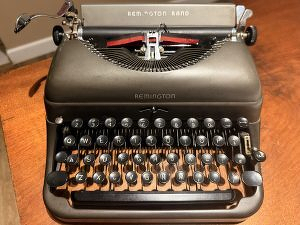
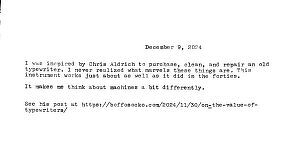
I was inspired by Chris Aldrich’s post to purchase, clean, and repair an old typewriter. I never realized what marvels these things are. This instrument works just about as well as it did in the forties.
It makes me think about machines a bit differently.
Stories about reality
Because Large Language Models are trained on human language about reality, their chatbots can often sound like they are in touch with reality. Sometimes they give remarkably lucid responses about things in the world that we would all agree with. But that can hide the fact that these models have no basis in reality whatsoever…only in the recorded interpretations of reality available to them.
Humans are meaning making machines. We are constantly interpreting the randomness of the world as stories which more or less work, but may also not be objectively true. This is why the events of the world continue to surprise us, or cause us anguish when they do not fit into our stories.
Chatbots don’t do that because they don’t know reality, just our stories about reality.
It would be like asking someone about the ocean who has read many books about the ocean, but has never actually experienced the ocean. You could learn a lot, but you’d always be a layer or two (philosophers can argue about this) removed from reality. And I think that makes a difference.
Other People's Projects
This is not an imposition, it’s a kindness. The point of a suspense file isn’t to nag others into living up to their commitments, it’s to form a network of support among collaborators where we all help one another make those conscious choices about what we’re not going to do, rather than having the stuff we really value slip away because we forgot about it.
This is important…I’ve often wondered about good boundaries around reminding other people of their obligations. Should I send out a reminder email about the meeting, or assume we’re all adults? Instead of seeing it though through the expectation of perfection, if I admit that we all need help (this is why I have a Getting Things Done system after all), reminding others turns into a collaborative system in which we’re all trying to do our best.
Fences
Pirkei Avot 1:1 & English Explanation of Pirkei Avot 1:1:1 from the Talmud
Making a fence around the Torah is another principle of supreme importance in Judaism. There are many laws that are not strictly obligatory upon a person from the Torah, but rather were instituted by the Rabbis to prevent a Jew from transgressing a Torah law. An example is the use of money on Shabbat. The Torah itself does not prohibit using money on Shabbat. However, the Rabbis said one should not do so, lest one write, which is prohibited by the Torah (at least the midrashic understanding of the Torah).Prior to legalism, with which my theological background is very concerned, there is a purpose for rules – to keep us out of trouble. I like the image of the fence one puts up to keep others from coming into harm. Here, the Talmud means the ‘lesser laws’ which keep one from encroaching on the Torah commandments. But really, aren’t all the rules a fence? They try to keep us from coming into harm. Just because we are bound to fixate on the fence and abuse it doesn’t mean it wasn’t put up with gentle kindness in mind. Even when we are impaled on it.
The American Crisis Discourse
But goodness, is it difficult to get many editors interested in books that aren’t somehow implicated in (or can somehow be shoehorned into) the American crisis discourse.The “American crisis discourse” is real and I think I’m infected: I often come across ideas and wonder where they fit into our crises. There is a difference between “how does this idea apply to now” and “how does this idea fit into the current outrage discourse.”
A Treadmill for the Mind
As a long time user and admirer of Apple’s products, I find myself in a new situation: I am not only unenthusiastic about the anticipated virtual reality headset – I’m against the whole idea. The headset sure seems like a step in the wrong direction for a company that recently has been so focused on health. In what way does a VR headset contribute to health? Mental, physical, social, whatever?
Steve Jobs was famous for using the analogy of the bicycle. Like a bicycle, a computer can enhance the natural power of a human. It’s like a bicycle for the mind. I’ve used my iPhone to help me find my destination. I’ve used my Apple Watch to help me train for athletic competitions. Bicycles.
Maybe I have poor imagination, but I can’t see a VR headset enhancing my natural power. Only tricking it. Sure, I can attend a more visceral virtual meeting. Maybe the attendees will even have legs. But it’s still a virtual meeting. Something that feels more real isn’t actually more real or healthy.
In that way, a VR headset feels more like a treadmill. You can move a lot, but never go anywhere.
It’s a treadmill for the mind.
Ten Minutes of Peace
If you use an iOS device and you’ve upgraded to iOS 12, do yourself a favor and add this Shortcut, “Ten Minutes of Peace”. You’ll need to download Apple’s Shortcuts app if you haven’t already.
All it does is turn on your Do Not Disturb setting for ten minutes and then turn it back off again. But during that time – no buzzing, dinging, vibrating: bliss.
Add it to Siri and get yourself ten minutes of peace just by asking.
Is Facebook evil? Everything bad about Facebook is bad for the same reason — Quartz
Is Facebook evil? Everything bad about Facebook is bad for the same reason — Quartz
Without question, Facebook enables brutal and immoral hatemongers. I can hear Facebook arguing that they cannot possibly take a stand on moral issues without becoming censors and losing objectivity. Facebook cannot make those decisions without messing up a lot of the time. I agree. Its scale is just too massive.
That’s just the thing: Facebook can’t admit it, but it’s possible that the most moral thing is for Facebook not to exist.
Seven Books I Have Loved
I can’t say ‘favorite’ because these are basically the earliest books I loved, or the latest books I have loved.
-
- Zen and the Art of Motorcycle Maintenance by Robert Pirsig
-
- A Field Guide to Ecology of Eastern Forests; North America by John C. Kricher and Gordon Morrison
-
- How to Be an Adult in Relationships: The Five Keys to Mindful Loving by David Richo
-
- Beloved by Toni Morrison
-
- Daring Greatly by Brené Brown
-
- A People’s History of the United States by Howard Zinn
-
- How the Mind Works by Steven Pinker
Oscar Romero, May 11, 1973
Even when they call us mad, when they call us subversives and communists and all the epithets they put on us, we know that we only preach the subversive witness of the Beatitudes, which have turned everything upside down to proclaim blessed the poor, blessed the thirsting for justice, blessed the suffering.
I’m Not Driving
I love my iPhone’s Do Not Disturb feature which mutes the parade of bells and vibrations that come from it. I use it at night so I’m not woken up to the ding of some robot account which liked one of my Instagram photos from four years ago.
I’ve always wanted to use it for temporary moments throughout my day when I don’t want to be disturbed, but after forgetting to turn it off and missing important messages on several occasions, I stopped trusting it for this purpose. It’s just too easy to miss the little moon icon up there reminding me.
But with iOS 11, Apple introduced a related feature: Do Not Disturb While Driving. It holds back on notifications like its older cousin of a feature, but it also won’t let you interact with the phone while it’s on. You have to press an additional button asserting “I’m Not Driving.” My phone automatically turns this on when I’m in the car, which is annoying in the short term, but better for me overall.
But I’ve actually started to manually turn on the feature – you can put it in Control Center – for those temporary moments of peace. And because of the way the feature is designed, it won’t let me use my phone until I turn it off. This way I can’t forget it’s on so long as I try to use my phone.
Which is too often.
Daring Fireball: Facebook Security Chief Said to Leave After Clashes Over Disinformation
That Sandberg and (presumably) Zuckerberg resisted investigating and disclosing everything they could about how the Russians took advantage of them says everything you need to know about them.The power that Facebook stewards is almost unimaginable, yet goes unchecked by regulation. I realize this is new territory for humanity, but leaving our fastest growing source of power in the hands of just a couple tech moguls is profoundly short sited.
The Horse
I’m stepping into a great big backyard. It’s familiar, yet new to me. It stretches on farther than I can see. It’s nice. I notice in the middle of the yard, there’s a small trailer. It makes me nervous because it looks…a little damaged. As I approach it, I can hear breathing sounds, quickening. There is a small window. I look in. I connect eyes briefly with a wild stallion and as soon as it sees me it panics. Jumping, kicking in the trailer. I fall backwards and then stumble up and away from the trailer.
Sitting on the porch I stare at the trailer. I can see it moving. The horse is pacing. I’m wondering what to do about it. I ignore it. I walk around it as far as possible, but I can’t stop thinking about it. At night I can hear the sounds.
So I throw a party. Loud music. Lots of people. There’s some caution tape around the trailer so no one gets hurt. And…for a moment…Yes! The sound is drowned. I’m feeling better than I’ve felt in a while. To keep it up, I drink, I laugh, I get a little reckless. Until I pass out.
But then the people are gone. The music has died. The drinks are out. And I can hear the horse and it’s angry. I’m angry. I can’t sleep, I can’t be free.
But I also have kerosene. I don’t know what this horse’s problem is, but it won’t calm down: I don’t really have a choice. Don’t judge me; I’m putting it out of its misery. As I pour the fuel around the trailer, the horse kicks wildly. The trailer may collapse before I’m done.
It doesn’t.
I watch the flames safely from the porch. I don’t know if I should say some words or something, but I wouldn’t know what to say. I didn’t even know its name. The trailer was moving, but now it isn’t. I feel sad.
The sadness kept me up all night, but the dawn’s light gives me hope. Smoke rises from the burnt out trailer which is still pretty intact. I approach slowly. Why am I so scared? As peer around the corner I’m breathless; I hear nothing inside.
But I see them. Eyes, open and sad but fierce. It kicks and neighs; I scream and recoil. Backwards, I fall.
Darkness.
Silence.
I must have hit my head. I’m on the ground and I slowly realize I’ve been lying just a few feet from a wild creature trapped in an attempted murder site. As my eyes regain focus they fall upon the horse’s eyes. It’s lying down, but its head is raised. I never noticed how beautiful its eyes are. There’s fire still in them.
I climb to my feet. So does the horse. I slowly approach. It breathes faster. Its knees are quivering and I realize mine are too. I can feel the hair on the back of my neck. It breathes loudly and I want to run. I have to run.
But I don’t. I just stay. As I keep breathing, I notice its scars. They’re from me. It hurts me to look at them. But I keep looking at them. The horse keeps breathing, too.
I stay. It hurts, but I stay. I just…stay.
I’ve lost track of time, but…sometime…later I notice the door on the back of the trailer. I do something risky: I unlock it. The horse watches me. I throw open the door and light streams in. The horse shivers and watches me.
It trusts me, so I climb on and we ride out together into the great country that surrounds us, faster than I could ever go on my own, feeling a dangerous wildness and an exhilarating trust.
Internet Friends: 1: How We Met on the Internet
This podcast about the internet and society really resonated with me, in particular, how each of the hosts described a time of great optimism for what the web could be, and how it’s all become pretty complicated and, um, disappointing in 2018.
So I thought about it and came up with my great (naive?) period of hope for the web. It was about 2006. I had stumbled upon a couple internet communities that were flourishing…
One was the show with zefrank, a quirky video blog that used a bunch of short, creative, and confessional segments by its creator. But notably it also encouraged, facilitated, and shared back contributions from the people who followed it. People were asked to (and did) submit little pieces of songs or sounds or pictures that Ze would put together in creative ways. The people who became the show’s community helped produce these cathartic pieces of group art. In today’s world — where groups of guys who’ve forgotten whether they are ironically or earnestly neo-nazis organize to abuse others on the internet — remembering old episodes of the show feels like remembering the internet’s Garden of Eden.
The other community was Radio Open Source, a public radio show and podcast hosted by Christopher Lydon (a name associated with the very beginnings of podcasting.) The setup of the show and the wide range of topics it covered fostered this incredible conversation on its website. Listeners shared insight from all kinds of perspectives that enhanced the context of each show and steered the direction of the next one.
Open Source has been through several incarnations through the years, and still exists, although I don’t think the community still does in the same way.
Pastor Lura N. Groen: Spiritual Abuse at the Meeting at ULS regarding Dr Latini
I understand Dr. Latini’s desire to control her own story and her own identity. And yet she has applied and accepted a position as a public face of a religious institution before being able to talk about parts of her religious life that were very public. Public theologians, and public representatives of institutions, need to be able to take responsibility for their public record, and to explain previous writings and actions.Context here.
I agree with Lura. There is a crucially important distinction between personal repentance and redemption and public accountability.
I expect more from the president and board of my alma mater or any institution.
Safety
Sen. Marco Rubio, in 2014, in a bid to raise his NRA rating from a B+ to an A:
The safety of our families is not something people should hope government can provide.Martin Luther and the Reformers, in 1530, in the Augsburg Confession:
[Government defends] not minds, but bodies and bodily things against manifest injuries, and restrain[s] men with the sword and bodily punishments in order to preserve civil justice and peace.I’d wager more Americans would agree with the 500 year old statement than with Sen. Rubio’s.
Explicit Bias
If your skin is white, like mine, I urge you to take the online Implicit Bias test conducted by Harvard University. They have several, but I’m specifically talking about the White-Black bias test.
You won’t like the results. Most of us white folk put a lot of energy into appearing to be unbiased based on race. Most of us get very defensive if called a racist. I admit to having a certain amount of ill-founded pride in being ‘very tolerant’ towards race — so I was very disappointed to find the test revealed that I had a certain amount of implicit bias. In other words, I automatically have a stronger positive feeling towards people of lighter skin than darker skin.
My first response (which is typical for people taking the test) was to blame the test. After all, I think racism is evil, and all prejudice based on skin color is wrong, and even dumb. But what the test measures is our ‘gut response,’ formed before the thinking part of the brain kicks in. Just take it and you’ll see what I mean.
Now that I’ve calmed down, I know it’s true. My experiences, conversations, media, and curricula have taught me to see dark skin in a more negative way. Think of a Disney villain…I’ll bet they have darker skin than the Hero. How many Bad Guys can you think of that have dark skin? How many mugshots have you seen on the news of folks with dark skin? I didn’t ask for this. But I am responsible for my response. These experiences form my automatic bias, and if I pass them on uncritically…well, I’m not one of the Good Guys.
I’m not a Bad Guy for having implicit bias, but my responsibility is to stop uncritically accepting the ways that my bias gets passed on or tolerated. I have to start with myself, so I’ve developed a list of ‘explicit biases’ that I want to train myself in. Just as our negative implicit biases take a while to learn, so will my correction to them.
When I encounter a person that is culturally, socially, economically distant from me, I run through a list. I affirm in my head that this person:
-
- is different from anyone else on the planet
-
- has a rich inner life that I may or may not see
-
- has an education that I don’t
-
- is embedded in family relationships, some of which may be complicated
-
- is embedded in social relationships, some of which may be complicated
-
- is a Child of God
Doors and Walls
I’ve been finding myself feeling frazzled pretty regularly which is something that happens when I haven’t taken time to review everything going on in my life from a ‘big picture’ perspective. Tasks are essential, but without a larger sense of goals and priorities they just become turns around the hamster wheel.
The problem for me is that I cannot get the big picture perspective without slowing down, stepping back, and doing honest-to-god thinking. And because I’m an introvert, I cannot do that in the midst of other people. I really have to take some time by myself to do that.
My office has a door and walls. The walls are permanent and meant to keep the environment out, and me in. The door, however, opens and closes – alternatively allowing things going in and out and then stopping things going in and out.
I’ve not been treating the door that way. I see the open door as symbolic of my openness to people. I like people and God knows I want them to like me. So I leave it open almost all the time. As if the door were a wall and of course I don’t want to put up walls between me and people.
But the alternative is not between walls and unrestricted access: I have a door. My door is here to selectively enforce boundaries that I – and I imagine, everyone else – need. There are times when I need to temporarily close off open access to me so that I can do some deep, reflective work. I may only need this a couple hours all week. But I do need it, and the door helps me take that time.
I need to be able to close my door without feeling like I’m putting up a wall. I’m just closing the door now, so I can better welcome others through it later.
How This Site is Built
Update to the Update: Site is now hosted on Wordpress with IndieWeb plugins.
Update: I’m now putting my microblog posts into the same stream as my blog posts. This required some pretty major changes to the structure of the site since my plugin options are limited on Github Pages. You can now subscribe to just the full (titled) posts, just the microblog posts, or both (the default feed.)
Here’s how I post blog posts to www.netfull.org and microblog posts to www.netfull.org/microblog as well as Micro.blog…
My blog, this blog, which is trying to tie together the various threads I’m interested in, is now hosted on Github Pages. It’s a static site built by Jekyll which means that Github builds it automatically every time I update the files.
The nice thing about building the site this way is it’s always under version control so there’s always a trail of bread crumbs back to any previous version of the site. I can revert back in time to fix the mistakes I regularly make while coding it. Also, the source is public so you can see the mistakes yourself.
I’ve been intrigued by Manton Reese’s Micro.blog project as an independent way to publish little thoughts and to have a little dialogue back and forth. Like the way I once thought Twitter should work, but without all the baggage. Twitter’s annoying attempts at monetization are understandable; Twitter’s enabling of White Supremacy, misogyny, and genocidal nuclear threats are unconscionable.
I really recommend you give it a try. I also recommend you pay a few dollars a month and get Micro.blog’s hosted service unless you really want to sink some hours into a painful, substandard, DIY system like mine.
For now ‘microblog’ posts, which you can think of like Tweets, don’t show up in the main JSON/RSS feed or on the homepage. Instead, they live on the Microblog part of my site. To get that set up, I relied heavily on excellent posts by Tim Smith, Ross Kimes, and Kirby Turner. You make fewer mistakes when you stand on the shoulders of others.